Before deodorant, before soap, before modern hygiene as we know it, there was perfume. And the story of how humans learned to capture scent and wear it on their skin is one of the stranger, more fascinating threads running through all of recorded history.
It Started With Fire
The word "perfume" comes from the Latin per fumum "through smoke." That's not a metaphor. The earliest perfumes were literally burnt offerings. Ancient Mesopotamians, Egyptians, and Hebrews burned incense in rituals going back 4,000 years or more, believing fragrant smoke carried prayers and sacrifices up to the gods. Frankincense. Myrrh. Cedar. These weren't luxury goods at first, they were religious necessities, and the priests who controlled them held enormous power.
Egypt took things further. They extracted fragrance into oils and resins, rubbing them on statues of gods, on the dead before burial, on the living before ceremonies. The word kyphi - a famous Egyptian incense blend, shows up in texts from around 1500 BCE with specific recipes calling for wine, raisins, resins, and dozens of herbs. These people were not messing around. Cleopatra, famously, had her sails soaked in rose water before she sailed to meet Mark Antony. Whether that's true or legend, it tells you something about how seriously fragrance was taken as a signal of power.
Persia, Arabia, and the Invention of Real Perfume
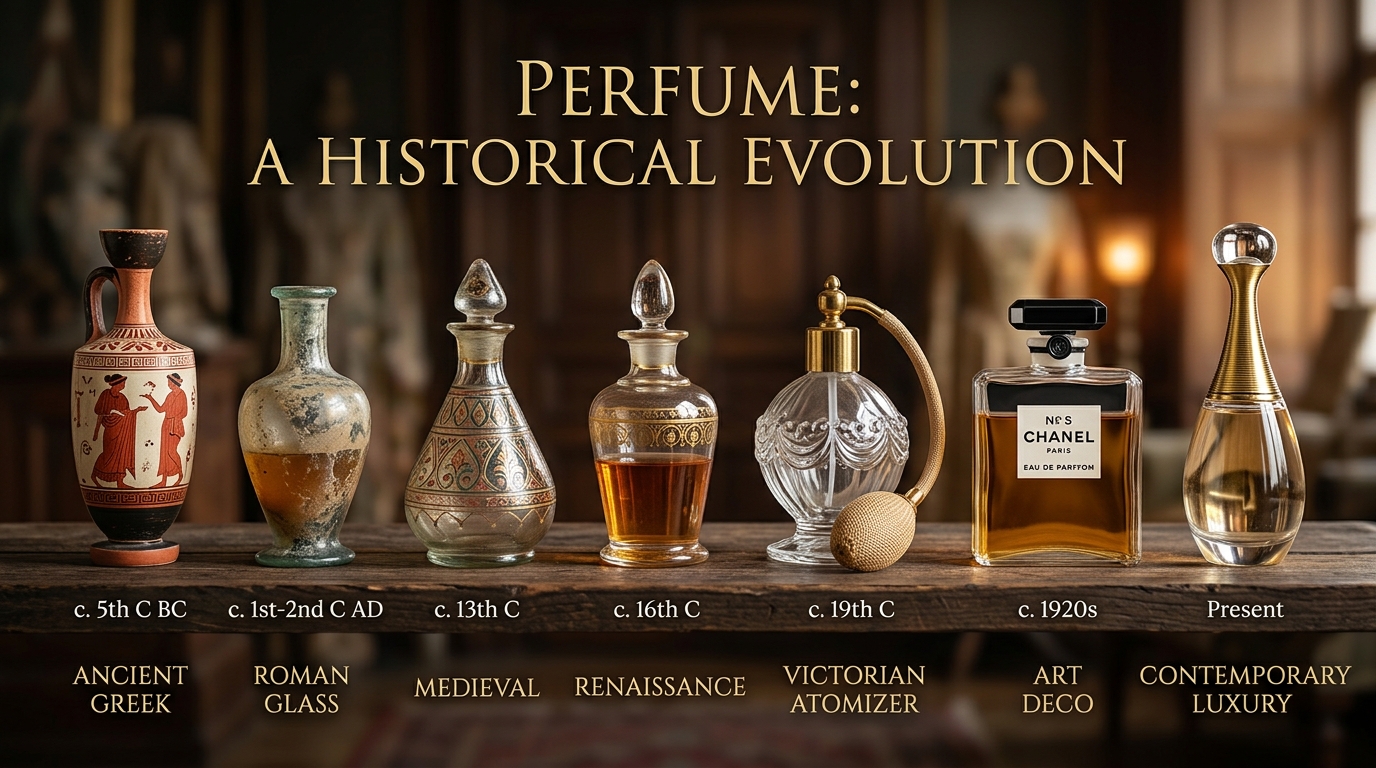
For a long time, fragrance was mostly fat-based oils infused with botanicals, or thick resins. What changed everything was distillation. The Persian polymath Avicenna (Ibn Sina), working around 1000 CE, is widely credited with refining the distillation process enough to produce true alcohol-based perfume. Suddenly you could capture scent in a form that was lighter, longer-lasting, and easier to apply than oil.
The Arab world ran with this. Medieval Islamic scholars and traders built a vast perfume industry connecting rose farms in Persia (the Fārs province gave us "attar of roses") to markets stretching from Spain to Southeast Asia. The roses of Shiraz and Kashan became famous across the known world. Perfumers in Baghdad sold complex blends of oud, musk, and ambergris ingredients that today would cost more per gram than most metals. Musk, derived from the glands of Himalayan musk deer. Ambergris, a waxy substance produced in the digestive system of sperm whales and found floating in the ocean. People wore these things on their bodies. History is strange.
But Europe Catches On — Eventually
Europe came to perfume relatively late, and it arrived through conquest and trade. Crusaders returning from the Holy Land brought back frankincense, rose water, and an appetite for things that smelled better than medieval Europe generally did. Trade with the Islamic world brought in more ingredients and techniques.
Hungary Water, produced in the early 14th century, is often called the first modern alcohol-based perfume in Europe essentially rosemary steeped in alcohol. It was made for the Queen of Hungary and supposedly helped her recover from illness. Whether it worked medically is doubtful. It smelled good, though.
The real turning point was Grasse, a small town in southern France that became the perfume capital of the world. It started with gloves leather gloves were the fashion accessory of Renaissance Europe, and Florentine tanners in Grasse began infusing them with local lavender and other botanicals to cover the smell of the leather. Eventually they dropped the gloves and just made the perfume. By the 17th and 18th centuries, Grasse was supplying the French court, which under Louis XIV became arguably the most fragrance-obsessed institution in European history.
Louis XIV is reported to have required fresh flowers at Versailles daily. He wore so much perfume that his courtiers nicknamed him the "Sweetest King." Given the bathing habits of the era, this made a certain practical sense.
The 19th Century: When Perfume Became Science
The industrial revolution hit perfumery hard... in the best way. Chemists in the mid-1800s started synthesizing aromatic compounds in laboratories for the first time. Coumarin (1868) smelled of fresh hay and tonka bean. Vanillin (1874) gave perfumers affordable vanilla without the plant. Synthetic musks followed. Suddenly perfumers could work with materials that didn't exist in nature, or that existed but were wildly expensive or ethically problematic.
This is when the perfume house as we know it emerged. Guerlain, founded in 1828. Houbigant in 1775. Coty in 1904. These weren't just merchants, they were artists working in a new medium. Aimé Guerlain's Jicky (1889) is sometimes called the first modern perfume: it blended natural and synthetic ingredients in a way that smelled abstract, not like any single flower or plant.
Then came Chanel No. 5 in 1921. Ernest Beaux, the nose behind it, used an unusually high concentration of aldehydes, synthetic aromatic molecules, to create something clean, abstract, and modern. Coco Chanel wanted a perfume that smelled like a woman, not a garden. It worked. It's still the best-selling perfume in the world.
The Modern Industry
Today, perfumery is a $50+ billion global industry. Celebrity fragrances, designer lines, artisan niche perfumers competing with mass-market names, the market is enormous and increasingly diverse. The big raw ingredients are still there: rose from Bulgaria and Turkey, jasmine from Grasse and India, oud from Southeast Asia. But synthetic chemistry does the heavy lifting for most commercial fragrances, with materials like iso E super, Ambroxan, and Hedione producing effects no natural ingredient can replicate.
The ethics of the industry have also shifted. Ambergris from whales is restricted in many countries. Musk deer are protected. Natural civet once harvested from civet cats in stressful conditions has been largely replaced by synthetic alternatives.
What hasn't changed is the basic human impulse behind all of it. We have always wanted to smell good. We have always used scent to signal status, attract partners, honor the dead, and please imagined gods.
The molecules have changed.
The desire is thousands of years old.